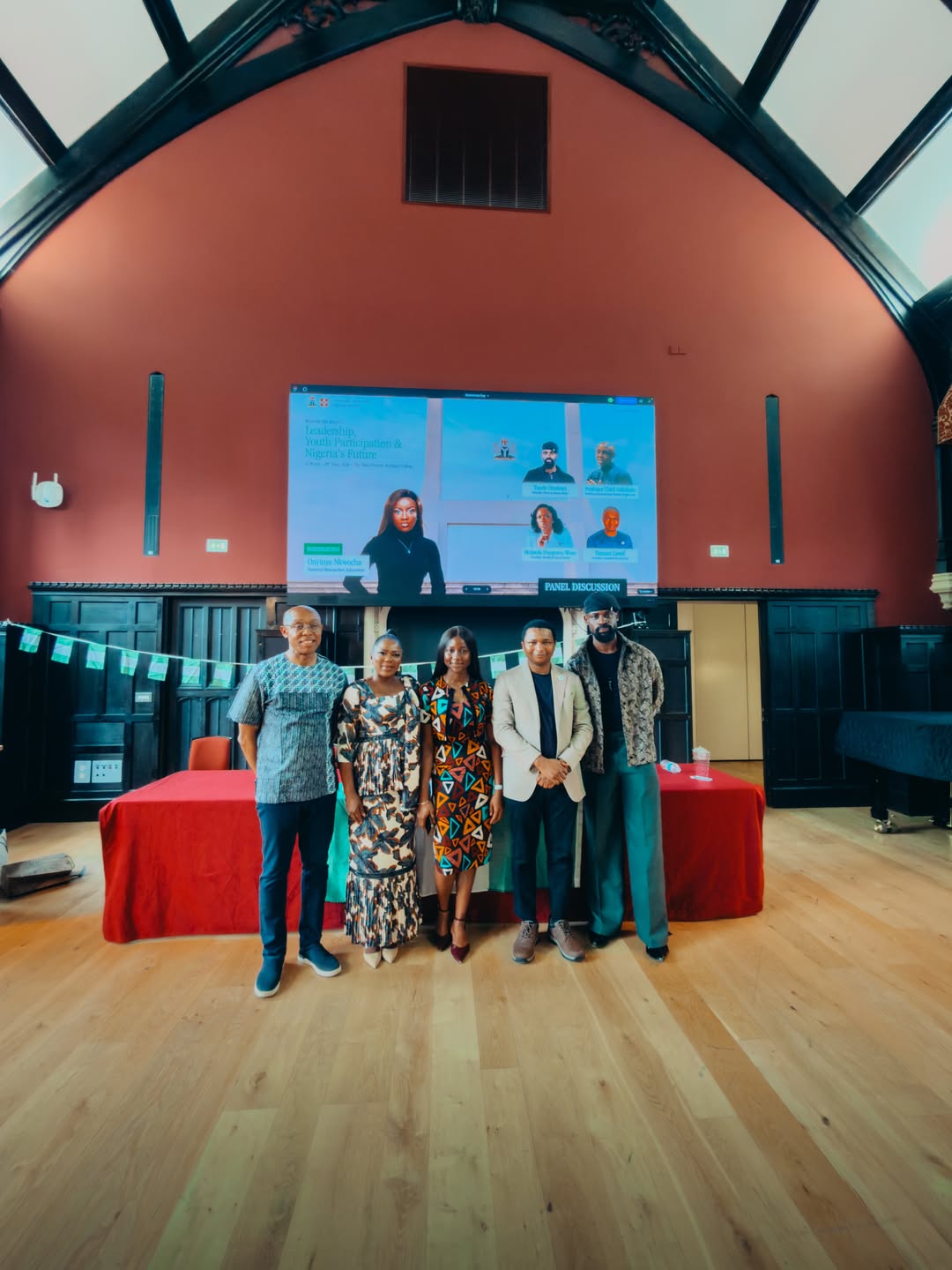
On Democracy Day, at the invitation of the Cambridge University Nigerian Society, President Moji Wusu delivered a thought-provoking address at St John’s College, Cambridge, on the theme “Beyond the Ballot: Leadership, Youth Participation, and Nigeria’s Future.” The event brought together students, scholars, and young leaders for a meaningful conversation about civic responsibility, leadership, and the role of youth in shaping Nigeria’s future.
Leadership Beyond Titles
Central to President Wusu’s address was a powerful conviction that has guided her leadership journey: leadership is not conferred by title; it is activated through responsibility.
In a world where leadership is often associated with position, status, or authority, she challenged the audience to embrace a different perspective—one that sees leadership as a choice rather than a designation. According to her, meaningful change begins when individuals take ownership of the challenges around them and commit themselves to creating solutions.
This message resonated strongly with a generation increasingly seeking purpose, impact, and relevance in an ever-changing society.
The Power of Responsibility
To illustrate this principle, President Wusu highlighted the inspiring work of Tunde Onakoya, founder of Chess in Slums Africa. Through his initiative, Onakoya has transformed the lives of countless children from underserved communities, demonstrating how a simple idea, driven by compassion and commitment, can create extraordinary social impact.
His story serves as a reminder that transformation does not begin with permission—it begins with responsibility. By choosing to act rather than wait, individuals can redefine possibilities for themselves, their communities, and the continent at large.
President Wusu pointed to this example as evidence that Africa’s future will be shaped by people who are willing to step forward, take initiative, and create opportunities where none previously existed.
Youth Participation Beyond Elections
While voting remains a fundamental pillar of democracy, the discussion emphasized that youth participation must extend far beyond election cycles. Active citizenship requires continuous engagement through community service, advocacy, innovation, policy conversations, entrepreneurship, and institution-building.
Nigeria’s young population represents one of its greatest strengths. However, unlocking this potential demands more than political representation; it requires cultivating a culture of responsibility, critical thinking, and sustained civic engagement.
President Wusu encouraged young Nigerians to recognize that their voices, actions, and contributions matter—not only on election day but every day.
Shaping Nigeria’s Future
The address ultimately served as a call to action. Nigeria’s future will not be determined solely by those who hold public office but also by young people who choose to lead in classrooms, communities, boardrooms, social enterprises, and grassroots movements.
The conversation at Cambridge underscored a simple but profound truth: leadership begins when individuals decide to become part of the solution.
As Nigeria continues to navigate complex social, economic, and political challenges, the nation’s greatest opportunity lies in empowering a generation that understands the connection between purpose, agency, and responsibility.
A Conversation That Matters
President Moji Wusu’s Democracy Day address was more than a speech—it was a refined dialogue on purpose, leadership, and the future of civic participation. By challenging young people to move beyond the ballot and embrace responsibility as a catalyst for change, she offered a compelling vision for a more engaged, innovative, and inclusive Nigeria.
The future of leadership, she argued, will belong to those who understand that influence is not measured by titles held, but by the lives transformed and the responsibilities embraced. And in that future, Nigeria’s youth will play a defining role.